From Neurons to Neural Networks
Me, Jina Nichols, Izzy Trudel
*****
April 2026
Overview
This was the last project for a seminar course I took in my first year, CSB198: Cell and Molecular Biology in Current Research and News. We were paired with
a biology graduate student, Cameron Parro, to create an infographic about his work for high school students (aka make it very easy to understand).
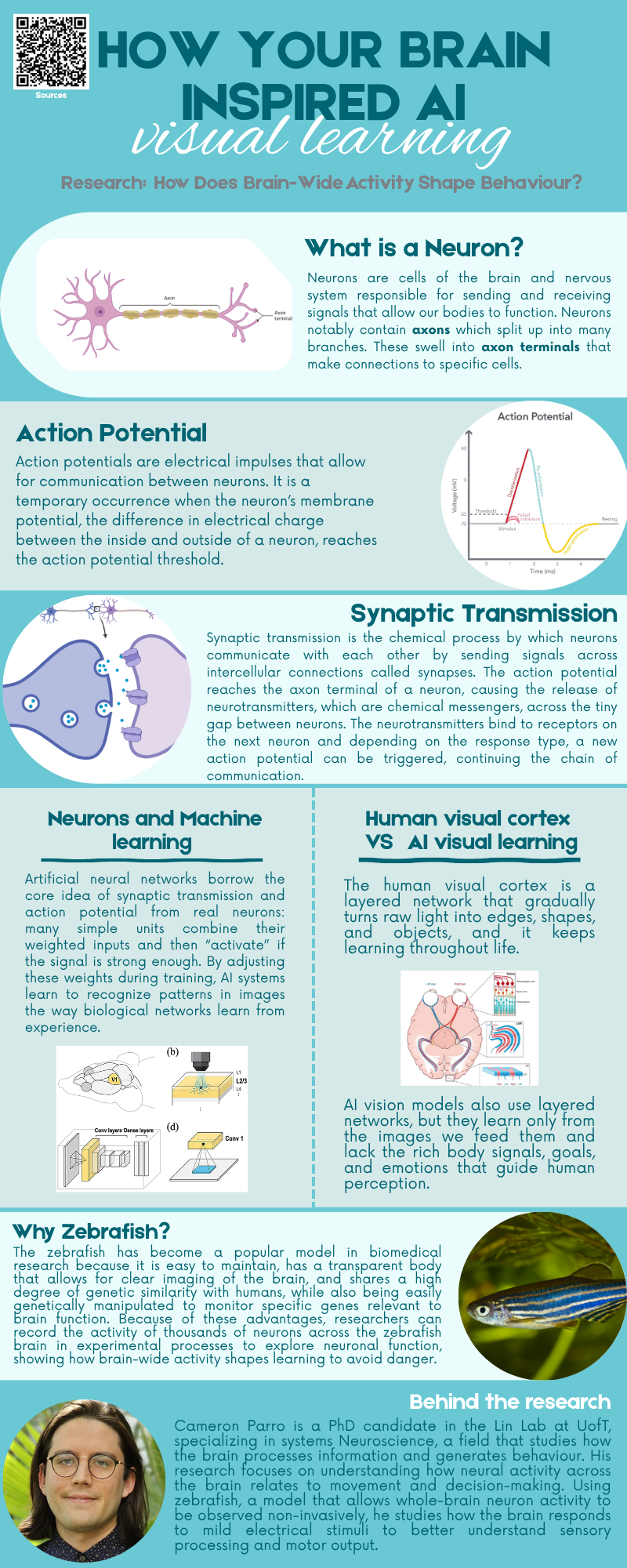
Cameron's research focuses on how brain-wide activity influences behaviour. Specifically, he studies nueron activity in the brain of zeebrafish, a common model organism in neuroscience research.
Mainly, his work was on understanding how the brain processes sensory information and how this processing influences behaviour. And to do so, he recorded neural activity from thousands of neurons across the zebrafish brain and related those activity patterns to behaviour (tail turns).
To be honest, this took me a good chunck of time to understand, as his first presentation to our class looked very techincal and intimidating 🤯. But he sat down with us and explained his work in a way that was much easier to understand, and I really enjoyed learning about it!
For the infographic, our professor wanted us to make it catchy and non-technical, yet most importantly, simple without sacrificing accuracy.
After thinking about it a little, I realized the impact his research had on ML.
Finally, after some work, here's our final product!
Extra Read: Course Reflection
CSB198 was a seminar (small class size) course, exploring cell and molecular biology in current research and news. The course emphasized a lot of experiential learning.
At the beginning of the course, I expected it to be relatively straightforward, as I was taking it to fill a breadth requirement only. I assumed that the content would be less demanding and
more focused on just general knowledge.
However, it was a lot more demanding, as we had to read research papers and had grad students coming in almost every week to present their
amazing (and very technical) research, but I was pleasantly surprised by how much I enjoyed it!
As someone who's been escaping bio since high school, it definitley took some work and a lot of googling to digest the content (especially the research papers).
But overall, my perspective on biology shifted from seeing it as a memorization-heavy and terminology-focused subject to seeing it as a dynamic field full of discovery and real-world impact. I defineltely
developed a greater appreciation for scientific research!
Additionally, this course also expanded my perspective on interdisciplinary work. As a computer science student, I was able to see how computational methods can contribute to biological research, particularly in improving detection techniques. This has encouraged me to consider how, in the future, I might apply my technical skills in areas such as bioinformatics or computational biology.
All in all, for me, this course changed biology from something I once avoided into a field I now see as relevant, interesting, and full of opportunities to connect with my future in computer science.